This is an advanced professional program designed for risk management, credit risk, and analytics professionals seeking a deep, practical understanding of economic capital frameworks and credit risk modelling used in modern financial institutions. This course provides an integrated look at how credit risk models support key risk functions - from estimating risk parameters and validating models to linking them with regulatory capital, provisioning (CECL/IFRS 9), stress testing, and strategic decision-making.
Participants will explore foundational concepts such as probability of default (PD), loss given default (LGD), and exposure at default (EAD), and how these feed into economic capital and portfolio credit risk measurement under Basel III/IV. Comprehensive coverage of model development, validation standards, macroeconomic scenario design, advanced analytical methods (including machine learning), and practical case studies ensures that learners gain frameworks and tools that they can immediately apply in real-world risk management settings.
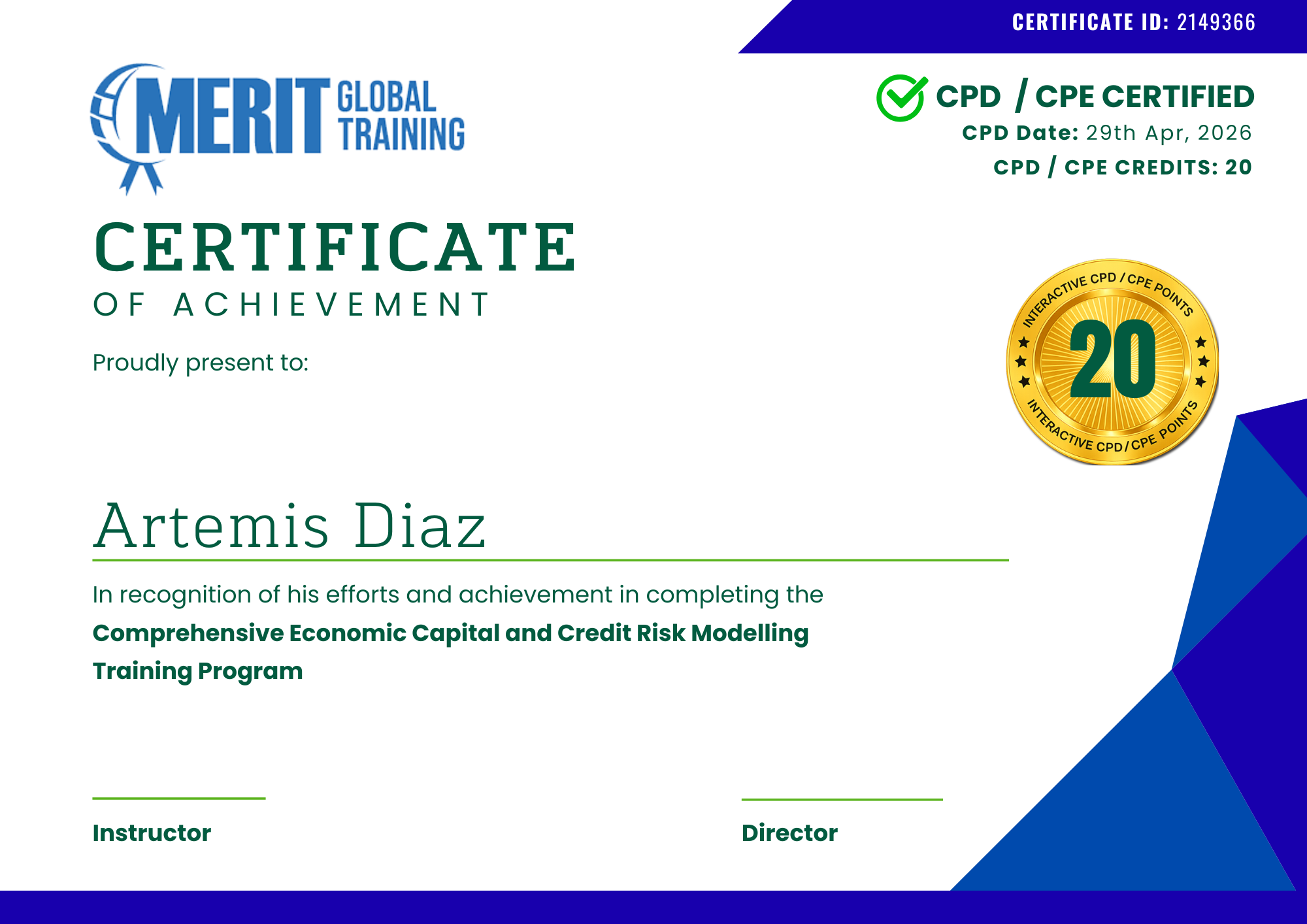
This programme delivers 20 hours of Continuing Professional Development (CPD) / Continuing Professional Education (CPE). Please note that it is a self-certified training initiative and does not carry formal accreditation from any external CPD or CPE governing body. Participants are strongly advised to consult with their respective professional, regulatory or membership organisations to determine the eligibility and recognition of these learning hours for their continuing education requirements.
Learning Outcomes:
Module 1 - Credit Risk & Economic Capital: Foundations and 2026 Context
Module 2 - CECL Methodology & Implementation Challenges (2019-2026)
Module 3 - Credit Risk Modelling Frameworks (PD, LGD, EAD)
Module 4 - Model Development Process & Validation Standards
Module 5 - Economic Capital Modelling & Portfolio Credit Risk
Module 6 - Forward-Looking Credit Risk, Macro Modelling & Scenario Design
Module 7 - Adjustments, Overlays & Management Judgement
Module 8 - Machine Learning & Advanced Analytical Methods (2026 Edition)
Module 9 - Stress Testing & Enterprise Integration of Credit Models
Module 10 - Case Studies, Practical Exercises & Final Assessment

Obtaining the Comprehensive Economic Capital and Credit Risk Modelling Certification with training provides professionals with the in-depth knowledge and practical skills necessary to understand and apply advanced risk modelling techniques. This training goes beyond basic concepts by teaching participants how to develop and calibrate economic capital models, assess credit risk exposures and integrate these models into the broader risk management and decision-making processes within financial institutions. The course includes coverage of key topics such as credit migration, stress testing, scenario analysis, loss given default (LGD), probability of default (PD), and expected loss (EL), making it ideal for credit analysts, risk managers, portfolio managers and financial engineers who are involved in credit risk analysis and capital management.
From a career and financial perspective, earning this certification with structured training significantly enhances professional credibility, marketability and earning potential. With increased regulatory scrutiny on financial institutions and an emphasis on strong risk governance, professionals who are proficient in advanced credit risk modelling and economic capital assessment are in high demand. Certified individuals often take on roles such as Credit Risk Modellers, Risk Managers, Financial Engineers or Capital Management Analysts, with annual salaries ranging from $80,000 to $130,000 based on experience and location. Senior or specialised roles in financial institutions may command salaries exceeding $150,000. By combining a recognised certification with practical, scenario-based training, participants not only enhance their technical expertise but also position themselves for leadership roles in risk management and capital strategy.











Build skills with experts anytime, anywhere. Keep up to date with the latest trends in your industry. Explore all of our courses and pick your suitable ones to enroll and start learning!
Hurry, Sale ends soon!
If you have any Queries about schedules Ask us here
More than 5 Participants ? Request for Corporate Training